
Chat!
How To Play Chess — special moves
- Overview
- How to set up the board
- Moves
- How the pawn moves
- How the knight (also called the horse) moves
- How the bishop moves
- How the rook (also called the castle) moves
- How the queen moves
- How the king moves
- The object of the game
- Stalemate
- Draw
- Special Moves
- Pawn Promotion
- Piece Value
- Player Ratings
Special Moves
There are two special moves that have not been talked about and have to be mentioned. They are en passant and castling.
En passant
En passant, which translates to "in passing", allows a pawn to capture its opponent's pawn that tried to pass it without confrontation if certain conditions are met. It is performed by white when white's pawn is on the fifth rank and the black pawn, which is on the seventh rank, moves to the fifth rank, trying to pass it without confrontation. In the case of black, it is performed when black's pawn is on the fourth rank and the white pawn, which is on the second rank moves to the fourth rank, again trying to pass it without confrontation.

There are a couple of things to note:
- En passant, if it's going to be done, has to be done at the first opportunity. For example, if white has a chance to perform En passant and instead moves another piece, white can not then perform En passant in a subsequent move.
- The pawns involved in En passant can only be separated by one column. Looking at the animated gif above, when white performs En passant, it is on the 'A' column and the black pawn is on the 'B' column. En passant could not be performed if, for example, white's pawn was on the 'A' column and black's pawn was on the 'D' column.
- White can not perform En passant if black first moves from the seventh to the sixth rank, then the sixth to the fifth. Black has to move straight from the seventh to the fifth rank in one move. Similarly, black can not perform En passant if white first moves from the second to the third rank, then the third to the fourth. White must move from the second to the fourth rank in one move for black to be able to perform En passant.
Castling
Castling is a move done between the king and either one of the rooks. It is a special move that allows you to put the king in a very protective position. Since the object of the game is to put the opposing king in checkmate (which means your opponent ultimately will be coming after your king), this move is extremely important. There are two types of castling: castling king side and castling queen side. They're both illustrated in the picture below. Castling king side occurs when the king, which starts on the "e" square, moves to the "g" square. The rook takes the new position shown in the illustration. Castling queen side has the king start on the "e" square and move to the "c" square.
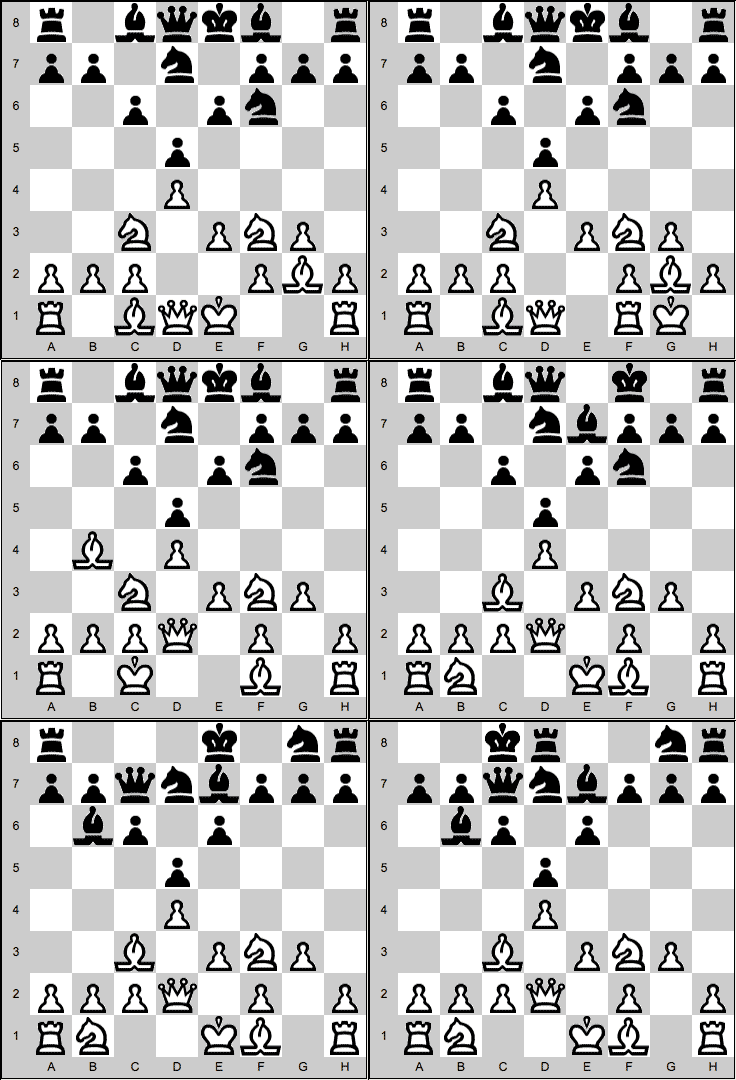
Again, the rook takes the new position shown above. There are a few conditions that must be met before castling can occur, however.
- Neither the king nor the rook involved in the castling may move before the castling occurs
- The king can not castle when in check.
- The king can not castle through a check
The first point is simple. For example, if you move the rook on the "h" square, you can not put it back, then perform castling king side. Once the rook on the "h" square has been moved, castling king side is no longer possible for the duration of the game. Similarly, moving the rook on the "a" square makes castling queen side impossible for the duration of the game, even if you put the pawn back first. If you move the king before castling, castling is simply impossible, both king side and queen side, for the duration of the game.
The second point is also straightforward. If the king is in check, you may not castle to get out of check. You must block the opponen'ts attack or capture the attacking piece, then perform the castle on a subsequent move.
The final point needs a little more explaining.
- If black's piece is attacking the "f" or the "g" square on the first rank, white can not castle king side (the image below displays this scenario).
- If black's piece is attacking the "c" or the "d" square on the first rank, white can not castle queen side.
- If white's piece is attacking the "f" or the "g" square on the eighth rank, black can not castle king side.
- If white's piece is attacking the "c" or the "d" square on the eighth rank, black can not castle queen side.

Looking at the picture above, white can not castle king side. Why? Because black's bishop is at B5 and is attacking A6, A4, C6, C4, D3, E2 and most importantly (the reason why white can't castle king side) F1. If white wants to castle king side, he can either move his queen to E2 (very bad move), move his knight on C3 to E2 or take the bishop with his knight at C3 (definitely the best move), then castle on the next move.
Solve This Puzzle?
| 8 |  |  |  | | | | |  |
| 7 | | | | | |  | | |
| 6 | | | | |  |  | | |
| 5 | | | |  | | | | |
| 4 | | | | |  | | |  |
| 3 | | | |  | | | | |
| 2 | | | | | | | | |
| 1 | | | | | | |  | |
| A | B | C | D | E | F | G | H |